The Grand Manan Art Gallery on Saturday, June 28, opened the First Annual "Square Foot Exhibit", which has been a great success.
The premise is simple: anyone can submit up to two pieces of art, upon submission of an entry fee of $25. But every piece must be 12" by 12", framed or unframed. All pieces would have the same selling price: $200, with the Gallery getting its percentage. This was to be a fundraiser for the Gallery.
A total of 96 pieces were submitted by 57 artists; 27 were from Grand Manan, and 30 were from elsewhere. There were different media used in the creations and a lot of imagination and creativity was evident on the walls of the gallery.
I haven't done as much painting recently as I should, but I really wanted to be part of this show, so I picked up a couple of 12" x 12" canvases. I decided that the subjects needed to be simple for this format So I painted a "Gull Soaring" for one of my pieces:
For the other, I painted a simple subject: a colourful "Lobster Buoy" on the open sea:
A large crowd came in for the opening night, and everyone had a grand time walking around looking at all the pieces on the walls. To add interest, each person there was given a ballot and asked to chose their three favorite pieces and write them down in order of preference and put the ballot in the box.
I know it was a difficult decision trying to figure out which ones to choose. (I didn't think it would be right to choose my own, so I avoided them and pondered my choices).
Anyway, Last evening I was pleasantly surprised to receive a call from David Ogilvie (the organizer of the show) to tell me that the "Lobster Buoy" was voted #2 for the show.
I told David, that one of his submissions had actually been my first choice for its brilliant colours and textures. All in all, this was a great idea, and kudos to David for organizing it.
Monday, June 30, 2014
Tuesday, October 22, 2013
Whale Breaching
I haven't been painting for a while, but after watching some whales perform out in the Bay of Fundy off Grand Manan, I thought I should try painting a whale breaching. So over the last several weeks, I have been working on this painting, finally put finishing touches on it this morning.
When a whale breaches, jumps out of the water, it makes a huge splash. It is an awesome display of power to propel such an enormous mass out of the water; quite exhilerating really. And I expect the whale feels pretty good too, showing off that kind of power. So it was quite a challenge to paint the spray sparkling as it slides off the whale and explodes off its fins.
These pictures were taken with the painting right on my easel, before the paint is even dry. I hope sometime soon to get good light conditions to be able to make prints of this painting to be available for people who would like a print of such a display of natural power.
I had taken lots of pictures of these amazing performances and selected one to help me get what it should look like. But having photos wasn't quite enough for me to be sure of what I was painting, so I looked up several sources on humpback whale anatomy. That way I could emphasize the features a little to be faithful to what the whale looks like.
When a whale breaches, jumps out of the water, it makes a huge splash. It is an awesome display of power to propel such an enormous mass out of the water; quite exhilerating really. And I expect the whale feels pretty good too, showing off that kind of power. So it was quite a challenge to paint the spray sparkling as it slides off the whale and explodes off its fins.
These pictures were taken with the painting right on my easel, before the paint is even dry. I hope sometime soon to get good light conditions to be able to make prints of this painting to be available for people who would like a print of such a display of natural power.
Monday, August 12, 2013
Fairway Buoy
Last week I did an oil painting of a fairway buoy out at sea, to which I have given the unimaginative title "Fairway Buoy":
I enjoy painting the sea, so I had fun with this, which is mostly sea, except for the red and white fairway buoy. I would have liked to have painted the buoy entirely red so that it would stand out better, but no; Transport Canada says it is supposed to be red and white, so I painted the buoy looking at the red side.
Fairway buoys are found off the entrances to harbours, and can be passed safely on either side. Being located well off from a harbour, fairway buoys encounter a lot of heavy sea in bad weather. My fairway buoy is contentedly cresting on a swell.
I enjoy painting the sea, so I had fun with this, which is mostly sea, except for the red and white fairway buoy. I would have liked to have painted the buoy entirely red so that it would stand out better, but no; Transport Canada says it is supposed to be red and white, so I painted the buoy looking at the red side.
Fairway buoys are found off the entrances to harbours, and can be passed safely on either side. Being located well off from a harbour, fairway buoys encounter a lot of heavy sea in bad weather. My fairway buoy is contentedly cresting on a swell.
Friday, August 2, 2013
Driftwood Frame
Quite often broken lobster pound slats that have drifted about the Bay, wash ashore in our cove. I hadn't paid much attention to them, but there are always possibilities.
My recent painting of a red lobster buoy in open ocean is an odd size, so a driftwood lobster pound slat seemed like a good candidate for framing the painting.
So I carefully cut out sections avoiding nail holes, mitred the corners and rabbetted a place to secure the painting, and viola! A Driftwood Frame.
The framed original painting will be for sale at my booth at the Rotary Community Market tomorrow, along with a few other originals and a whole lot of prints, map posters and note cards. See you there!
My recent painting of a red lobster buoy in open ocean is an odd size, so a driftwood lobster pound slat seemed like a good candidate for framing the painting.
So I carefully cut out sections avoiding nail holes, mitred the corners and rabbetted a place to secure the painting, and viola! A Driftwood Frame.
The framed original painting will be for sale at my booth at the Rotary Community Market tomorrow, along with a few other originals and a whole lot of prints, map posters and note cards. See you there!
Friday, March 29, 2013
Oil painting of open sea
Well, today I did my first oil painting in about 30 years. I have been thinking about trying oils again after being reminded of it by seeing an image of my oil painting "Dory Memories", painted about 30 years ago. I have been mostly working in acrylics, quicker drying, perhaps a little more forgiving.
But oil paint has a richness to its colour and texture you can't get with acrylic. So I went to Luke's store "Endeavours" in Fredericton (great store for art supplies, by the way) and picked up some water-soluble oil paints, which are also almost odourless (another problem with regular oil paints).
Since I hadn't done this for so long, I decided my first oil should be a small canvas to try it out, just 11" x 14". So what to paint? Well, for me it had to be ocean, and what better to paint that open ocean:
Since it is oil paint, I expect it will take days to dry, so I photgraphed it on the easel:
I hope to make some prints of this too, if it seems that people like it. As far as the buoy goes, I have no idea whose mark it is, or even if it is a local mark, but the colours worked for me in the picture:
Perhaps the richness of colour and testure will convince me to spend more time working in oils once again:
I enjoyed this return to oils; perhaps I will do some more soon
But oil paint has a richness to its colour and texture you can't get with acrylic. So I went to Luke's store "Endeavours" in Fredericton (great store for art supplies, by the way) and picked up some water-soluble oil paints, which are also almost odourless (another problem with regular oil paints).
Since I hadn't done this for so long, I decided my first oil should be a small canvas to try it out, just 11" x 14". So what to paint? Well, for me it had to be ocean, and what better to paint that open ocean:
Since it is oil paint, I expect it will take days to dry, so I photgraphed it on the easel:
I hope to make some prints of this too, if it seems that people like it. As far as the buoy goes, I have no idea whose mark it is, or even if it is a local mark, but the colours worked for me in the picture:
Perhaps the richness of colour and testure will convince me to spend more time working in oils once again:
I enjoyed this return to oils; perhaps I will do some more soon
Tuesday, March 19, 2013
"Sculling the dory"
This framed print is a reproduction of a painting I just completed, "Sculling the Dory", an art not as common now, with outboard motors being used to propel a dory
This painting depicts a dory being used by weir fishermen to tend a Grand Manan herring weir.
The two men in the dory are going into a herring weir, to make sure the fish are still inside and see how many are there.
Here, the dory is being manoeuvred into the weir between nets hung on the weir poles and the “drop”, a net across the mouth of the weir to hold the fish inside the weir.
The fisherman with the oar is “sculling” the dory, working the oar back and forth, twisting it each way so that it cuts through the water like a propeller blade and pushes the dory forward. The stern of the dory has a notch in it that acts as an oarlock for sculling. "Sculling" allows a dory to be propelled in tight quarters where there is not room enough to spread oars to row.
This painting depicts a dory being used by weir fishermen to tend a Grand Manan herring weir.
The two men in the dory are going into a herring weir, to make sure the fish are still inside and see how many are there.
Here, the dory is being manoeuvred into the weir between nets hung on the weir poles and the “drop”, a net across the mouth of the weir to hold the fish inside the weir.
The fisherman with the oar is “sculling” the dory, working the oar back and forth, twisting it each way so that it cuts through the water like a propeller blade and pushes the dory forward. The stern of the dory has a notch in it that acts as an oarlock for sculling. "Sculling" allows a dory to be propelled in tight quarters where there is not room enough to spread oars to row.
Friday, February 8, 2013
Dory Memories
About thirty years ago I did an oil painting of a dory on the back of Grand Manan Island. I was quite pleased with how it turned out, and it wasn't long before it was sold and off to a new home in Ontario.
Well, recently the owner kindly made the image available for me to make prints of the painting, to be able to share it with others who, I hope, will like it as much as I do.
The whole painting is intended to convey the grand peacefulness of the back of Grand Manan Island, with cliffs in the background in softer colours.
The water has a light ripple, which dances with reflected colours.
And of course, the old man rowing his dory is deep in thought, drinking in the grandeur of the cliffs and delighting in the solitude; the only sound being the gentle splash of his oars dipping softly into the water and the soft creak of the oars in the thole pins.
Well, recently the owner kindly made the image available for me to make prints of the painting, to be able to share it with others who, I hope, will like it as much as I do.
The whole painting is intended to convey the grand peacefulness of the back of Grand Manan Island, with cliffs in the background in softer colours.
The water has a light ripple, which dances with reflected colours.
And of course, the old man rowing his dory is deep in thought, drinking in the grandeur of the cliffs and delighting in the solitude; the only sound being the gentle splash of his oars dipping softly into the water and the soft creak of the oars in the thole pins.
Wednesday, December 5, 2012
200 years ago today brig Plumper lost
The Fundy coast of New Brunswick did not take the War of 1812
terribly seriously as a national conflict.
W. Stewart McNutt provided some interesting insight into this era in his
book “New Brunswick: a history, 1784 to 1867” which was published almost fifty
years ago.
The primary effort in this region of
the Province was to capitalize on the hostilities for economic gain for the
provincial ports. This attitude played
before the backdrop of the American Embargo Act of 1807, which forbade the
sailing of any American or foreign vessel from the United States to foreign
ports for commercial purposes. This
ill-conceived attempt to build domestic industry and markets by cutting the
United States commercially from the influence of foreign trade, was quickly
countered by the Free Ports Act, passed by the British government, to open
specified ports of the Maritime Provinces to American shipping. Halifax, Shelburne and Saint John were the
first, with St. Andrews added in 1811. Indeed,
the many coastal indentations of Passamaquoddy Bay, next to the American
border, made St. Andrews a preferred port because of better opportunities for
smuggling. The border ports of New
Brunswick and Maine, therefore, became beehives of illicit trade.
With the outbreak of the War of 1812, Great
Britain thought it to be of strategic advantage to encourage New Englanders to
continue a profitable exchange of goods across the border, in spite of the
wishes of Washington, the motive being to deepen political divisions within the
country. The result was an air of
neutrality in the Bay of Fundy, where greed for trade took precedence over
bellicose politics. Indeed, the citizens
of Eastport, Maine, unanimously voted to maintain good relations with the
people of New Brunswick.
Breaking the American embargo was a
most lucrative business opportunity, so the war effort of New Brunswickers was
primarily directed at trade with the enemy.
American vessels that had broken the embargo and sailed into the Bay of
Fundy were hospitably received. Below
the border there were indignant allegations that some Yankee skippers
deliberately surrendered the vessels as "prizes" to the British Navy,
were safely escorted to Saint John where their valuable American cargoes were
unloaded at a good price that enabled them to "ransom" their vessels
and sail home with the proceeds of profitable trade.
To carry out this trade, American
vessels had to elude their own country's warships, but were then hospitably
received and escorted by the British Navy.
Privateers, on the other hand, had been given letters of marque to prey
upon enemy vessels, and their motives were directed toward personal gain rather
than national economic strategy. As a
result, there was a delicate tension in effect, where privateers hunted for
American vessels with lucrative cargoes, but these same vessels obtained escort
by His Majesty's navy, intent on assisting the trade that enriched New Brunswick
ports. The busy shipping activity took that
place during the war of 1812 would appear entirely confusing to any outside observer. Besides keeping privateers in check and
escorting illicit American trade, naval vessels were also used to move about
soldiers, militia and other citizens among the ports, as land transport was
almost non-existent.
Because of the activity of privateers
around the mouth of the Bay of Fundy, from either side of the border, passengers wishing
safe passage and those shipping valuables, travelled aboard naval vessels,
being afforded the protection of powerful guns and the authority carried by
these. Considering the slight threat
from engagement with U.S. naval ships and the clear dominance over privateer
armament, His Majesty's naval vessels represented the most secure marine
conveyance. One such naval vessel was the Brig Plumper, belonging to the
Royal Navy. A Saint John newspaper
recorded the movement of vessels such as these, for their arrivals always
sparked interest in the port, for this was the way that the most influential
persons of the day might arrive in the city.
After arriving in Halifax on November
30, 1812, with a convoy of six vessels, His Majesty's Brig Plumper then
set out from Halifax for Saint John with a full complement of seamen and
several passengers. But even the dominance of
the Royal Navy could not prevail against the unforgiving elements. At four o'clock on Saturday morning, December
5, 1812, the Plumper ran ashore at Red Point, a little
over a mile down shore from Dipper Harbour, which is in turn a little over 20
miles down the shore from Saint John. The
spot she struck is exposed to strong winds blowing in from the mouth of the Bay
of Fundy, a shallow cove below a steep and rugged cliff. In the darkness, confusion and heavy seas,
with the brig fast breaking up and going to pieces, those on board attempted to
reach the shore, so near, and yet beyond grasp for so many.
When daylight arrived and the
survivors huddled on the bleak shore took stock of their situation, they found
that their cold, wet, bedraggled group numbered only thirty. The only officer to make it ashore was
midshipman Stephen Hall, who landed safely along with the pilot, Samuel
Simpson; the rest were sailors and marines.
Their commander, Lieut. Bray, had been lost, along with the brig's
master, Captain Marley. In total,
forty-five persons were lost - officers, crew, marines and passengers.
Shortly after daylight, messengers
were despatched through the thick woods to Dipper Harbour, and thence the
message was taken on to Saint John, conveying the news of the catastrophe and a
summary of the lost and survivors. The
report also noted that the Plumper had been carrying nearly $30,000 in
specie, but added that it was expected to be saved. The authorities in Saint John wasted no time
in responding. On Sunday, December 6, H.
M. Schooner Bream and the government sloop Brunswicker set sail
for Dipper Harbour to pick up the survivors at the wreck and assist in saving
what could be recovered.
On Monday evening, December 7, the Bream
arrived back in Saint John with the survivors picked up from the wreck of the
lost Plumper. The newspaper of
the following week published a list of those who were lost in the tragedy and
those who survived. But no mention was
made of the specie, whether recovered or lost.
The notion of treasure persisted down
through the following century and a half; I recall hearing of it from an old
hard-hat diver in the 1960's. In the
early 1970's, a Saint John diver, Gary Austin, scoured the bottom thoroughly in
the area of the lost Plumper, looking for clues to the existence of the
shipwreck and possible treasure. With
all the speculation on the possibility of gold and silver coins, green-eyed
divers took a keen interest in what he was doing. Gary had cooperated with the New Brunswick
Museum in what he was doing, and his responsible approach was rewarded by a
letter in September, 1972, from a provincial Minister of the New Brunswick
Government, declaring
"the site of an historic wreck considered that of HMS Plumper to be an
historic site and also a protected site".
Enough was found to suggest that this could indeed be the site of the Plumper
wreck: heavily encrusted cannon,
pieces of old iron encased in thick concretion.
I visited Gary Austin and, with his
cooperation and directions, dived on the wreck site in August, 1973. The remains of the Plumper lie in
fairly shallow water in, very exposed to rough sea, under a cliff of red rock
at Red Point. The sea floor there is
made up of rocks, boulders and rubble, with rocks moved about in every
storm. Whatever might be left of the
wrecked brig would be badly beaten up, strewn about and buried.
When I first went down on bottom, I
could see no sign of wreckage anywhere.
To be satisfied that this was actually a wreck site, I wanted to find at
least some traces of shipwreck. Finally
I found some badly decomposed fragments of very old iron, scattered, partly
buried in rubble. Certainly the divers
working on this site faced a daunting task.
Were it not for the dreams of the existence of buried treasure, I doubt
that anyone would have bothered with this shipwreck site. Considering the unstable bottom, subject to
heavy sea breaking to bottom, the New Brunswick Museum should count itself
fortunate to have acquired as many items from this site as it did.
The story and scant remnants of the Plumper
are a direct link to the interesting naval activities of the War of 1812. While we cannot diminish the importance of
this catastrophe in loss of life, with forty-five lives being snuffed out that
bleak December morning, it was the intrigue of sunken treasure, whether or not there
was any actually there, that piqued such intense interest in this
shipwreck. Were it not for the dreams of
treasure, perhaps these traces of this shipwreck would never have been found,
and the Plumper would have been a forgotten tragic event. But dreams of gold and silver kept the Plumper
alive in the lore of the Bay, and with her story we are reminded of the
interesting role of the Southwest Fundy coast in the 1812 hostilities between
Great Britain and the United States.
Monday, October 29, 2012
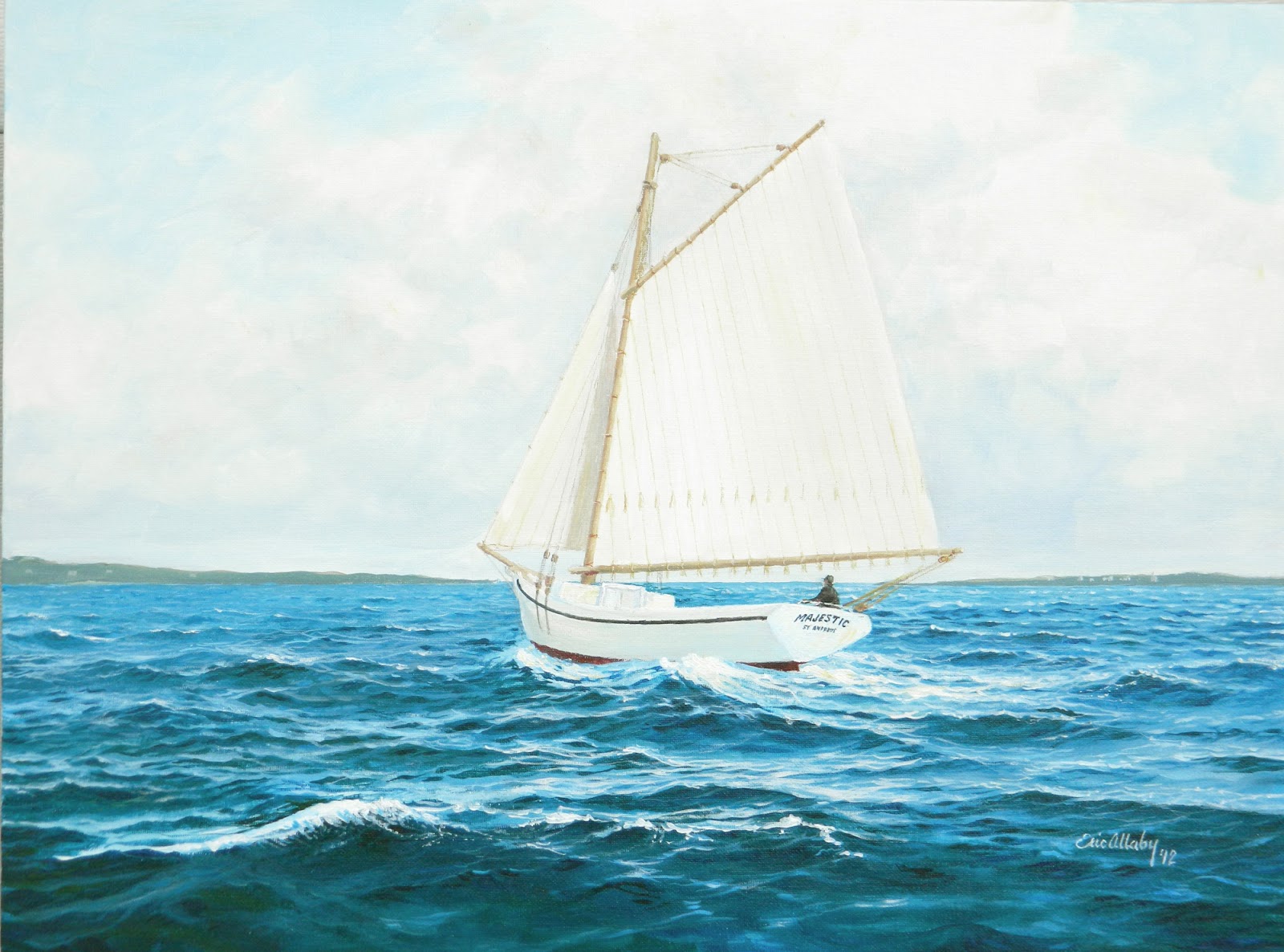
The Sloop "Majestic"
I recently completed a painting of the sloop "Majestic" built at North
Head, on Grand Manan Island, in 1902, by William Alexander Flewelling. Originally owned by William and Frank
Flewelling, she was subsequently owned by John A. Ingersoll, of Seal Cove. I had a couple of old photos of the “Majestic”
grounded out in Seal Cove harbour, which is what I used to create the painting.
It was in the Seal Cove context I wanted to depict the sloop, so I painted her sailing up the Seal Cove Sound, in a typical afternoon sou’wester.
One of the challenges in this painting was to depict seas breaking away from the viewer. Most sea paintings show waves breaking toward you, but to be consistent with the wind in the sails, I needed to paint waves breaking away from me, where little trails of foam are left behind the breaking wave.
This was a fun painting to do; challenging, but with rewarding results. I will soon have prints of this painting available. So, for any of Seal Cove’s John A. Ingersoll descendents or relatives, a print of this painting might be a great gift to keep your family in touch with your heritage!
It was in the Seal Cove context I wanted to depict the sloop, so I painted her sailing up the Seal Cove Sound, in a typical afternoon sou’wester.
One of the challenges in this painting was to depict seas breaking away from the viewer. Most sea paintings show waves breaking toward you, but to be consistent with the wind in the sails, I needed to paint waves breaking away from me, where little trails of foam are left behind the breaking wave.
This was a fun painting to do; challenging, but with rewarding results. I will soon have prints of this painting available. So, for any of Seal Cove’s John A. Ingersoll descendents or relatives, a print of this painting might be a great gift to keep your family in touch with your heritage!
Friday, September 7, 2012
Dark Harbour Dory print
I just completed a painting of a dory in Dark Harbour at sunset
The dory depicted in this painting is dated before outboard motors, when the stern board was notched for single-oar sculling, moving the oar back and forth across the stern, while changing the angle of the blade to give foreward thrust.
I will have prints of this available at Market tomorrow and hope to have some in stores soon too.
The dory depicted in this painting is dated before outboard motors, when the stern board was notched for single-oar sculling, moving the oar back and forth across the stern, while changing the angle of the blade to give foreward thrust.
I will have prints of this available at Market tomorrow and hope to have some in stores soon too.
Monday, August 20, 2012
River Steamer "Majestic"
Excursions along the Saint John River were popular at this time of year a hundred years ago. And one of the steamers providing the river cruise was the popular "Majestic".
The "Majestic" was built in Toronto in 1899, and ran up an down the Saint John River from 1902 until she was retired in 1942, making this one of the last steamboats in regular service on the river. She was the first steel hull steamer to ply the Saint John.
A coal fired steam engine ppowered her screw propeller to give this steamer great dependability on her service about the Saint John River system
Mention the "Majestic" and many of our more elderly Saint Johners will still remember her with the fondness of a pleasant nostalgia
The "Majestic" was built in Toronto in 1899, and ran up an down the Saint John River from 1902 until she was retired in 1942, making this one of the last steamboats in regular service on the river. She was the first steel hull steamer to ply the Saint John.
A coal fired steam engine ppowered her screw propeller to give this steamer great dependability on her service about the Saint John River system
Mention the "Majestic" and many of our more elderly Saint Johners will still remember her with the fondness of a pleasant nostalgia
Thursday, August 16, 2012
Lumpfish
This is the time of year when a lumpfish turns his mind to thoughts of family. He not only turns his mind, but turns his skin colour too.
For most of the year, a lumpfish is blue grey in colour, but during the breeding season, the male turns orange. Not only that, but the male guards the eggs too.
When I was diving, I always enjoyed running into these cute little fellows, so when the Huntsman Aquarium asked me to do a painting of sea life, I chose a lumpfish to paint.
They are not particularly streamlined, nor do they have big fins and powerful swimming muscles. In fact, quite often when the tide is running hard, they simply cannot swim against it. Quite often around the herring weirs, we would see lumpfish pressed against the twine by the tide, unable to swim against the current.
For most of the year, a lumpfish is blue grey in colour, but during the breeding season, the male turns orange. Not only that, but the male guards the eggs too.
When I was diving, I always enjoyed running into these cute little fellows, so when the Huntsman Aquarium asked me to do a painting of sea life, I chose a lumpfish to paint.
They are not particularly streamlined, nor do they have big fins and powerful swimming muscles. In fact, quite often when the tide is running hard, they simply cannot swim against it. Quite often around the herring weirs, we would see lumpfish pressed against the twine by the tide, unable to swim against the current.
Friday, July 27, 2012
"Seal Cove Crick, 1968"
Last week my cousin Marg showed me a painting I had done for her in 1968. I had forgotten about it, but apparently I had visited with her and her family in Halifax, and in appreciation, I painted them this painting of "Seal Cove Crick". And no, that's not a spelling mistake; in Seal Cove, it's not "The Creek", it's "The Crick".
Seal Cove, near the southern end of Grand Manan, was a busy little harbour in the 1960's; a lot going on there. Depicted in the painting, we have a purse seiner tied up at the General Marine boat repair shop, getting some repair work done.
Seal Cove also had its own little sardine cannery. Tied up to it is a sardine carrier, heavily laden with sardines, ready to unload to provide another day's packing for the workers there.
Marg loaned me the painting to make prints from it so that others could enjoy the memories of the busy little harbour that was "Seal Cove Crick"
And I will have framed prints of "Seal Cove Crick, 1968" at the market too.
Seal Cove, near the southern end of Grand Manan, was a busy little harbour in the 1960's; a lot going on there. Depicted in the painting, we have a purse seiner tied up at the General Marine boat repair shop, getting some repair work done.
Seal Cove also had its own little sardine cannery. Tied up to it is a sardine carrier, heavily laden with sardines, ready to unload to provide another day's packing for the workers there.
Marg loaned me the painting to make prints from it so that others could enjoy the memories of the busy little harbour that was "Seal Cove Crick"
And I will have framed prints of "Seal Cove Crick, 1968" at the market too.
Sunday, June 24, 2012
"Grand Manan V"
With the ferry "Grand Manan V" resuming summer duties starting tomorrow, this seems like a good time to introduce my painting of this ferry just completed recently
Every ship has some special characteristics that you associate only with that ship. For me, the most striking feature of the "Grand Manan V" is how little fuss she makes powering through the water. If you ever watch her sail by, she slides throught the water making hardly any wake at all. The designers at Knud E. Hansen sure did a great jobs with the hull lines under water to get the hull to part the water so effortlessly. Accordingly, I painted the ship in very calm water, trying to convey that very smooth and minimal wake.
When she was designed in Denmark and built in the Netherlands and delivered to commence service to Grand Manan in August, 1990, the designers provided an attractive rendering on the funnel of the provincial galleon logo on blue waves, that was copied on the new "Grand Manan Adventure".
And, of course, to give it a universally understood Grand Manan context, I have depicted the ferry sliding smoothly past Swallowtail Light.
I will have prints of this painting at markets this summer, if anyone is interested in seeing them, or perhaps purchasing one as a gift for someone who might have fond memories of the 20+ years this ship has given us.
Every ship has some special characteristics that you associate only with that ship. For me, the most striking feature of the "Grand Manan V" is how little fuss she makes powering through the water. If you ever watch her sail by, she slides throught the water making hardly any wake at all. The designers at Knud E. Hansen sure did a great jobs with the hull lines under water to get the hull to part the water so effortlessly. Accordingly, I painted the ship in very calm water, trying to convey that very smooth and minimal wake.
When she was designed in Denmark and built in the Netherlands and delivered to commence service to Grand Manan in August, 1990, the designers provided an attractive rendering on the funnel of the provincial galleon logo on blue waves, that was copied on the new "Grand Manan Adventure".
And, of course, to give it a universally understood Grand Manan context, I have depicted the ferry sliding smoothly past Swallowtail Light.
I will have prints of this painting at markets this summer, if anyone is interested in seeing them, or perhaps purchasing one as a gift for someone who might have fond memories of the 20+ years this ship has given us.
Monday, June 18, 2012
Merganser and Ducklings
This is the time of year we find mother ducks showing their little ducklings how to forage for food in the tidal shallows of our Fundy coves.
Here is a print of my painting of a Merganser with her little ducklings.
The female Common Merganser looks like she is having a "bad hair day", with the tuft on the back of her head.
What a steep learning curve for the tiny ducklings to try to learn to feed and fend for themselves in so short a time.
Here is a print of my painting of a Merganser with her little ducklings.
What a steep learning curve for the tiny ducklings to try to learn to feed and fend for themselves in so short a time.
Sunday, May 13, 2012
Yellowlegs
Some yellowlegs arrived in Our Cove a few days ago, as they do every spring. This year they seem to be running a few days late. We make a note when they arrive each year, and it usually ranges from the last few days in April to the first few days in May. We enjoy their distinctive call as they scurry about, foraging along the intertidal shore.
So it seems like a good time to feature my "Yellowlegs" print in the shop:
This fellow is depicted standing on a rock in the early mornig sun, with the tide up, waiting for it to ebb and expose the seaweed which hosts all sorts of interesting things a shorebird loves to eat.
The rocks present interesting lighting in sun and shade:
Of course, that makes for interesting reflections to paint in the water:
The early morning sun on the water teases the colour palate choices, which makes for fun in painting:
Our yellowlegs will soon be heading further north for the summer, but we look forward to seeing them in late August on their southerly migration.
So it seems like a good time to feature my "Yellowlegs" print in the shop:
This fellow is depicted standing on a rock in the early mornig sun, with the tide up, waiting for it to ebb and expose the seaweed which hosts all sorts of interesting things a shorebird loves to eat.
The rocks present interesting lighting in sun and shade:
Of course, that makes for interesting reflections to paint in the water:
The early morning sun on the water teases the colour palate choices, which makes for fun in painting:
Our yellowlegs will soon be heading further north for the summer, but we look forward to seeing them in late August on their southerly migration.
Subscribe to:
Posts (Atom)